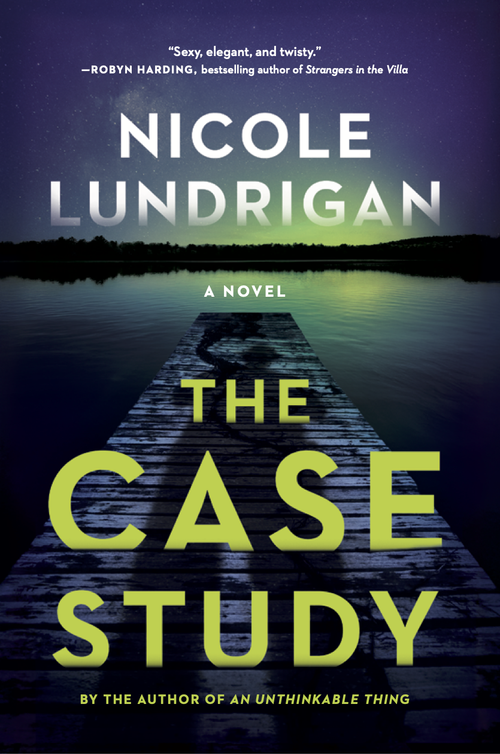
The Case Study
Prologue
He is dead.
I'm lying on the dock beside him, staring at the surface of the lake. Minutes, hours, days have passed. What does it matter? The sun won't stop sinking. Zigzags of light melting into the black water. I whisper, Please don't go, but darkness still arrives, fear pinning me to the wood. My mind twitches with imaginary colors, and behind me, the shadowy pines scratch and crackle. A twig breaks. I hear heavy footsteps, one-TWO, one-TWO. The sounds soon align with my pounding heart.
I adopt his position. Legs splayed, neck cricked. Dark red palm facing upward. I tell myself I am air. No longer bound to the body that surrounds me. With a single exhale, I leave this awful place. Same as he's done. Floating up and up, past the roof of the cabin where we stayed. Soaking into leaves and insects. Hiding inside the lungs of an angry crow.
I no longer need to think about what happened. How it all went so terribly wrong.
My uncle is dead.
I am dead too.
I've always been capable of that—convincing myself. Of just about anything.
Journal of Abnormal Psychology
Cotard's Syndrome: Case Study of a Juvenile
Abstract: Cotard's (walking corpse) syndrome was first defined by French neurologist Jules Cotard, who used the phrase "le délire de négation" or "the delirium of negation" to describe it. The patient maintains a complete denial of self.
At the age of fourteen years, LK experienced a significant traumatic event—the violent death of her uncle. She was then isolated with the decedent's body for three days in remote wilderness. Later charged with manslaughter, she was deemed unfit for trial and transferred to a secure psychiatric facility. At that time, a comprehensive examination revealed severe dehydration and sun exposure, but no evidence of physical or sexual abuse.
Upon admission, LK presented with unabating delusions, repeatedly claiming she no longer existed and demanding to be brought to a morgue. She also described corporeal decay and olfactory hallucinations of rotting odors. In addition, she exhibited dermatillomania and occasional self-starvation. Catatonia was intermittent. Based on those behaviors, a diagnosis of Cotard's syndrome was confirmed.
Rehabilitation efforts were intensive and multipronged. The initial course of treatment involved body movement therapy, administering of antipsychotics, and twelve sessions of electroconvulsive shock spaced twice weekly. Recovery was spontaneous eleven months after onset, at which point talk therapy (including CBT and DBT) were fully integrated. LK remained at the facility, per court order, until she reached the age of twenty-one.
Chapter One
Control was only an illusion. Mia understood that, but she couldn't resist tapping the app on her phone. The icon was a stylized green leaf, with the word Branches beneath it. Anyone gazing over her shoulder might think it was related to nature or health. Not family monitoring software hidden in plain sight on her home screen. Which was the point, she supposed.
Within milliseconds, she was staring at a map of the city of Callow. The app then zoomed in to her neighborhood, where she noted a blinking blue dot gliding along Main Street. It passed the ice cream shop and then a clothing store. In the app, Mia was considered the tree, and her teenaged daughter was an offshoot. A single branch. Bringing the phone closer to her face, she waited for the dot to veer left into the residential area. That would confirm Elise was heading home.
"What's so captivating?"
Mia glanced up. Her husband was seated at the oversized marble island in their kitchen. She'd already placed a bowl of soup in front of him, plus a slice of crusty sourdough bread.
"Nothing. Skimming an article."
"About?"
"It's not important, Ian," she said, waving the air. "Just silly fashion trends."
"Then you could at least join me. Be good to chat a little."
Chat a little. Such a simple request, though it made Mia's jaw clench. As Ian gazed at her, she attempted a smile. His face and forearms were tanned and his light brown hair was beginning to gray, especially in his beard. He was wearing his usual tortoiseshell glasses, which gave the impression of both intelligence and boyishness. She used to find that combination disarmingly handsome, and now she wondered if she'd ever feel that way again.
"All good. I'll eat with Elise."
She was about to close the app when the dot stopped. It hovered in position for several seconds, then seemed to slide through a wall. For a moment, it vanished, then reappeared behind the buildings. She knew exactly where that was. A dingy laneway, full of dumpsters and rats. Rickety metal staircases that led to second-floor apartments. A few college students lived there, but it was mostly unsavory men hanging over the railings, smoking weed. The branch had stopped moving.
Quickly she texted. Where are you?
Within seconds, her phone dinged: at cs omw. C's meaning Chloé's place. Elise's best friend who lived in a beautiful three-story house several blocks south of them. Nowhere near that blue dot.
Dinner's getting cold. HU.
hu??
Hurry up.
lol nt
"Really, Mia. Can't we share a meal together? She's fifteen, and she'll be home when she's home."
Nothing ever fazed Ian. No matter the circumstance, he maintained a continual calm. As though everything was either fine or fixable. That facade had always troubled Mia. He seemed incapable of grasping the dangers a girl might face, or the panic that enveloped a mother when her child disappeared. Even if that simply meant forgetting to text or check in. Mia no longer tried to share her worries with Ian, as he was prone to slipping into "psychiatrist mode." Normalizing Elise's irresponsibility and instead hinting at Mia's "issues."
She put down her phone, then scooped a single ladle of soup into a bowl and placed it on the island. Without sitting down, she leaned forward to take a bite, and a faint odor of sweat tweaked her nose. She was still wearing athletic shorts and a sweat-wicking top from her afternoon run. She wasn't trying. Not like she used to. And while Ian never commented, surely he'd noticed her low-level apathy.
He reached over and placed his warm fingers on top of hers. "This is nice, no? You and me?"
She waited for several seconds. Then eased her hand away. "Mm. Nice." She glanced at her dark screen, itching to check the app again.
"And the house is coming along, isn't it? This area looks great."
"Getting there." She smiled again.
Even though they'd moved four months ago, it still felt chaotic with unopened boxes and mounds of unsorted belongings. Ian was the one who'd insisted they pack up and sell. While they hadn't gone far, the new house was larger and grander. A huge airy open concept. The front contained a formal living-dining area, but she preferred the back of the home. The kitchen, eating nook, and family room were combined into an enormous and functional living space. An ideal spot to create family memories. Ones that weren't tainted by her husband's betrayal.
Ten months ago, she'd learned about his affair. Mia had often suspected cheating; Ian was handsome and flirty, but there was never proof. No racy emails or dinner receipts stashed in a jacket pocket. She'd chocked it up to her own insecurities. Until she noticed a streak of good old-fashioned lipstick on his collar. Almost laughable, if it hadn't shattered some part of her. He would tell her nothing about the woman, but eventually Mia worked up the nerve to ask if he'd brought her into their home. He denied it, but she wondered if they'd had sex in their bed. Or lounged naked on their sofa. Or gotten soapy and slippery in the ensuite shower. Maybe it was all true. Maybe none of it was.
"Oh, I had a bit of good news today," he said. "A request of sorts."
"About?"
"Do you remember that case study I—"
Before he could finish, the front door slammed. "I'm ho-ome!"
Elise's voice echoed through the house. Thunk, thunk of her combat boots, and quick steps across the foyer and down the hallway into the kitchen. She was wearing a bright green hoodie that Ian had bought her. Oversized and overpriced. Mia frowned at the skinny white legs sticking out from beneath it. Anyone's guess if there were shorts underneath.
"Have a seat," Ian said, patting the stool beside him.
Elise flumped down. Folded her arms across her chest. "What's that awful smell?"
"Soup," Mia said.
"Seriously? In June?"
"Summer soup. I made it vegetarian for you." She put a bowl in front of her daughter. Then held her breath for two seconds before saying, "So, how was Chloé's?"
"Same." Elise shrugged, picked up a spoon, and poked at bits floating in the broth.
"You went there after school?"
"Yup."
"Huh. That's nice." A sharp cramp of aggravation shot through Mia's insides. Elise had developed the capacity to lie without so much as a blink. A trait she'd no doubt inherited from her father.
"Does Chloé have summer plans?"
Another shrug. "We're figuring stuff out."
"What did you two get up to then?" In general, Mia liked Chloé. She was polite, bright, and worked hard in school, even though it was a struggle. She had a learning disability and attention-deficit. The inattentive kind.
"Seriously, Mom? We hung out, okay? That doesn't mean we, like, did anything."
Mia exhaled loudly. Half of her wanted to yell at her daughter for the snarky tone, while the other half wanted to fold her up and tuck her away. To keep her slender bones and fuzzy hair and freckled face safe from all the perverts and the perils.
Ian nudged Elise's arm. "How about we enjoy dinner?"
Elise sipped from the very tip of her spoon and grimaced. Then let the utensil clatter into her bowl. "Sorry, Mom, but this is just bad. Tastes like licorice. And not the good kind."
"That's a bit harsh, isn't it?" Ian glanced at Mia. "But I get it. Fennel bulb's an acquired taste."
"Well, let it be known I hate fennel ball. Or whatever this is."
The cramp behind Mia's ribs intensified, and she brought her hand to her sternum. As each year passed, it was becoming harder to accept the utter monotony of her life. Wife to an unfaithful husband. Mother to an entitled teenager. Not to mention that since the pandemic, her career had stagnated, and her friendships evaporated.
"You don't have to eat it," she said.
"Phew!" Elise blew out air and then grinned at Mia. "And no offense, okay, Mom? I appreciate you making it." Then she slid off her stool and drifted downstairs. She'd begged to have the nanny suite on the lower level, and Ian had agreed. He thought the arrangement offered the right amount of privacy for everyone.
"Guess we learned something new about our daughter tonight." He chuckled with an annoying lightness.
"I guess." She took another mouthful of her soup, then asked, "So, you mentioned someone needs a favor?"
"Not a favor, no. More of a proposal." Folding his cloth napkin, Ian placed it beside his empty bowl. "Do you recall the case study that was a feature piece some years back?"
"How would I? I mean, you've published so much."
"It was in the Journal of Abnormal Psychology. The one where the patient had Cotard's syndrome."
Mia hesitated before she spoke. "Was it a young woman? Something happened, and she developed a weird delusion?"
"Good memory."
"Rings a vague bell." Which was a fib, as she'd remembered instantly. Back then, she'd been both fascinated and unsettled by the case, and if she were completely honest, more than a little caught up with it all. The subject of the study had lived right there in Callow, and as a young teen, had attacked and killed a relative on a seemingly carefree summer vacation. She was then trapped in the woods for days with a decomposing corpse. The property owner eventually discovered them, and when questioned, the girl made the outlandish claim that she, too, was dead. A breathing ghost. Her psychosis was so rare, summaries of the journal article Ian had written were printed in national newspapers and magazines. Even made the cover of People, which was where Mia first read about the unusual delusion.
"The editors are compiling an anniversary edition and want to include a selection of pivotal studies from the past. That particular case being one of them."
"So reprinting it?"
"Not quite. I'll need to review and recapture it through a modern lens. Evaluate the analysis and treatment using current psychiatric paradigms." He scraped the handle of his spoon back and forth over the lip of the bowl. "I was considering adding an addendum."
"Like an update? As in, how she's doing today?"
"Essentially, yes."
Mia leaned forward, the cold edge of the countertop pressing against her hip bones. "I'm confused. How could you even reach her?" Ian had treated her at Albethey Psychiatric Institute, a facility about forty minutes outside Callow. But she'd been released, of course, and after all those years, could be anywhere. Have any name or occupation.
"That won't be too difficult," he said, tugging at his ear. "I'm sure."
She noticed her palms were clammy against the marble. "Have you kept in touch? Do doctors even do that? Stay connected with former patients?" Not just former; decades had passed.
His face changed then into unreadable blankness. "I can't discuss details, Mia."
"Sorry. I know." Perhaps Albethey kept track of former patients, especially when criminal conduct was involved. Using a softer tone, she said, "And if she agrees to talk, how might that work? Am I allowed to ask?"
A firm nod. "Of course. Likely over video. But who knows if she'll say yes. Who knows if I'll even go that route. The deadline's months away, so I've got time to decide."
Then Mia uttered the words she was supposed to from the start. "That's fantastic news, Ian. Being one of the experts included in this special edition. Must feel good."
"It does feel good." He pushed back his stool and stood up. "Well, I've got some review to do, darling."
"About her?"
"Yes. I should dig out the files at least." When he reached the bottom of the staircase, he stopped. Then said, "I do worry about you, you know. You just seem . . . distracted. Even mildly depressed, I would say."
"Me? I'm totally fine. Bit tired is all." Which was mostly true?
He nodded grimly, then floated, almost effortlessly, up the stairs to his office.
Chapter Four
I felt as though I was breaking the rules. Sneaking away to see another man without telling Andrew. Not that he knew anything about my former relationship with Dr. Morrison. Or those shitty years of my life. He'd never be able to comprehend the complexity of it, or how it had shaped me in ways I couldn't begin to untangle. And I certainly did not have the desire to explain.
Campus was much quieter than I'd expected, even for summer semester. I noticed a few clusters of students sitting beneath leafy trees. Others loitering on the stone steps of buildings. Everyone had books and coffee, wore shorts and vintage tees. The scene made me agitated, how young and uninhibited they all appeared. Having normal experiences. Not confined to a nuthouse getting "multi-pronged treatment" simply for being broken.
I quickly stepped inside a building. The cramped hallway was dimly lit, had skinny windows and a musty odor that was uncomfortably familiar. Fitting for a place that studied the recesses of unsound minds. Like my own. Or how mine used to be. Though perhaps I was being generous with my self-perception.
Lowering my ball cap, I eased open the door of the lecture hall and slipped inside. Took a seat near the very back. The room was cool enough to make my bare arms prickle. Once my eyes adjusted, I saw that there were only about twenty students scattered among the seats. The room's capacity was easily over a hundred.
Dr. Morrison stood at the front, left elbow balanced on a lectern. He had to be in his mid-fifties by now. His hair was the same shaggy brown, and his body was still slim but definitely thicker around the middle. He was wearing a crisp white shirt with the top two buttons undone. Giving the impression he was relaxed, but not trying to entice his mostly female audience.
As he moved about, organizing his papers, I sensed something different about him. His shoulders were no longer square. His back had the slightest curve. Overall, he looked like an average older man. During the long nights at Albethey, I often slipped my hands inside my underwear while thinking about him. Willing him to come to my room at night and press himself on top of me. It never happened, of course, and I could be forgiven for such childish fantasies. It was slim pickings at the asylum.
"I'm sure you'd all prefer to be outside on this gorgeous day," Dr. Morrison said. "Instead of sitting in the dark discussing perversion." A ripple of giggles. Then he opened his laptop, pressed a few buttons, and huge black text appeared on the massive screen behind him: Paraphilic Disorders.
Clicker locked in his fist, he began moving through slides. Defining the various behaviors that were considered deviations from society's norm. Voyeurism. Exhibitionism. Fetishism. "Studies are ongoing to identify the etiology and underlying physiology associated with these disorders. Some investigations indicate a biological root cause." Then he shifted gears. Discussed how cultural constraints have influenced psychiatry's perception of sexuality. Explaining that healthy individuals may engage in activities that are acceptable within particular subcultures. "So, if that's the case, would they still be defined as deviant?"
Hands shot up.
I had to smile. After last night's hotel room with Tim and Tiff, the irony of this specific lecture was not lost on me.
A stream of lively chatter ensued between several students and Dr. Morrison. Some comments were just plain stupid, but he was never dismissive. Instead he offered counterpoints, provocative questions, subtly shifting their understanding. Observing how he managed the room, altering others' thinking in such sneaky ways, I found it quite clever. I'm sure he had done the same with me back when we were a team.
My early days at Albethey were a painful blur. Even now I found it difficult to articulate my experience during those initial months. Other than I was nothing but also everything. Limited and limitless. I felt neither comfort nor pain. Joy nor sorrow. Hunger nor thirst. At times I could communicate, but there were also moments when panic surged. Especially when I hyperfocused on the body that surrounded me. Examining myself, I would see a gnarled hand. A veiny leg. A limp strand of dirty hair. I was convinced I was spoiling, flesh falling away from my own bones, and those sights sparked such acute fear, I would completely shut down.
But over the days and months, the delusions receded. It wasn't an instant recovery, more so a gradual ebbing. I doubted I ever required the strong drugs or shock treatments. I simply responded to warmth and encouragement. Dr. Morrison's presence, his exploration into my distorted thought patterns, even his tone of voice all gave me a sense of security. I developed what I would consider a mild preoccupation with him. Psychiatrists use the term enmeshment, which meant blurred boundaries. On my side, at least. But who could blame me? Inside the utter tedium of that institution, he became the face of my existence.
After I was released, I struggled to acclimate to life on my own, and my adoration soon disintegrated into loathing. First, Dr. Morrison's availability decreased. Our appointments petered out to only once per month. The final straw was when my "story" appeared everywhere. Likely I'd given permission, as I'd signed every document he'd plopped in front of me. Or perhaps nothing was required from me at all. And so there I was. Entirely alone, while sordid details about my life and my breakdown were all over the place.
Even though my identity was kept secret, I still felt exposed, and I spent several years trying to hide. It took me a while to get my head straight. To unscrew what he'd screwed over. But eventually I realized I didn't need Dr. Morrison. I was able to look upward and, like everyone else, see only a godless sky.
As I was the sole beneficiary in my uncle's will, I had the financial means to care for myself. I inherited his estate, which included all his belongings and investments. The "Slayer's Act" did not apply to me. I was never convicted of murder. Never even formally charged, though that important detail was often omitted in salacious write-ups.
Long after people had forgotten about me, I began to weave myself back into society. I completed an undergraduate degree in business. To my chagrin, I was unable to work a regular job. Interactions with my peers were often fraught, and any sort of stress seemed to mess up my thought processes. HR dubbed me "unpredictably reactive." Afterward, I turned to intense fitness, drinking up the temporary endorphin rush of CrossFit and Ironman. When that faded, I landed on yoga, believing it held the secret to wholeness. I trained as an instructor and began to teach a few classes each day. I learned to ground, to stretch, to breathe. To hide the revulsion I felt toward my own existence. How I'd always been nothing more than a fucking board game that others played. That was how I'd viewed it, anyway. Mostly still do.
"Okay, okay." Dr. Morrison's deep voice sliced through the animated chirping. "Let's get back on track here." The next slide appeared. Some statistics. A couple of no-brainer statements. One: Paraphilia was almost exclusively identified in men. And two: Masochism was the exception, which was twenty times more prevalent in women. His eager students typed furiously on their laptops.
As I watched my former psychiatrist work the room, I tried to sift through the sensations in my chest. A tightness. Or a tremulousness? This was a tough one, but the challenge was not new to me. I'd always had difficulty identifying and labeling my inner states. Emotions seemed infinitely complicated. Apparently, it was a legit shortcoming, though the medical name escaped me now. One in ten people, Dr. Morrison once explained, had no words for their feelings.
Perhaps I needed to take a step back and instead consider the internal shift I'd noted since receiving his email. Maybe the emotion was furious longing. Or incensed wistfulness. Two couplings that kind of made sense, given the situation. I'd made plenty of mistakes when I was young. Though, in all honesty, it hadn't been my intention to sideline my life. I was simply convinced it was the right decision. I accepted that the suffering I'd endured at Albethey was deserved. I had it coming. But now, with the benefit of many years in the rearview, I wasn't so sure.
All day I'd been having these curious and unsettling thoughts. What if the dark things from my past could be set straight? I'd survived the ordeal of youth. But also had not survived. I lived each moment pulsing with covert rage. My mind trying to both protect me and destroy me. What sort of life was that? I might as well have stayed dead.
And the primary question that tickled the base of my throat: What if I could be different?
I pulled out my phone and opened his email again. Him contacting me that way was certainly a breach of privacy. Yet the whiff of desperation was appealing. I composed a quick reply and, without thinking any further, clicked Send.
He glanced at the lectern and then put up his hand. "Sorry, sorry. I need to check this."
Picking up his phone, he tapped his screen. And in the moments before I left the lecture hall, I saw a grin spread over his face.